

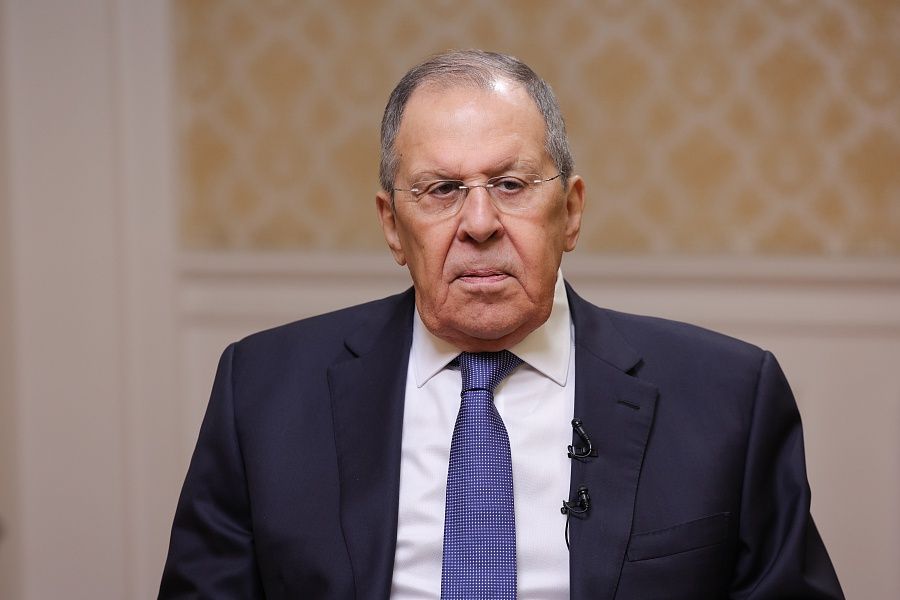
Russian Foreign Minister Sergey Lavrov offered a mixed assessment of relations with the new Trump administration this week, describing the dialogue as “pragmatic” while expressing bewilderment at what Moscow perceives as contradictory signals involving ongoing sanctions and attempts to marginalize Russian economic interests.
In a wide ranging interview with Al Arabiya, Mr. Lavrov revealed that Moscow and Washington have agreed to establish a bilateral economic working group alongside ongoing political talks in Geneva, aimed at resolving what he called a fundamental disconnect between diplomatic assurances and continued economic warfare.
“US President Donald Trump said something that may seem elementary for a normal person. Disagreements always happen… This does not mean the parties are supposed to stop communicating with one another,” Mr. Lavrov said, citing Mr. Trump’s stated desire to end the war in Ukraine, which he has characterized as “Joe Biden’s war.”
However, the foreign minister pointed to actions that seem to undermine this spirit of engagement. “A couple of weeks after Alaska, out of the blue, for the first time since Biden’s presidency, the Donald Trump administration announced US sanctions on Lukoil and Rosneft,” he noted. Washington has also pressured India to halt Russian oil purchases and issued an OFAC resolution permitting Venezuelan oil production while explicitly barring Russian, Chinese, Iranian, and North Korean involvement.
“While the Americans sincerely told us that, once the Ukraine issue has been settled, we can begin mutually beneficial cooperation, for now, they have been trying to force us out of global energy markets,” Mr. Lavrov said. The new economic working group will seek to clarify Washington’s definition of “mutual benefits.”
Turning to Ukraine, Mr. Lavrov delivered a blistering indictment of European leaders, accusing them of duplicity and what he termed a resurgent “Nazi essence” that precludes any constructive role for Brussels in peace negotiations.
He traced the conflict’s roots to the 2014 Kiev coup and subsequent Ukrainian laws banning the Russian language and the canonical Orthodox Church. The Minsk agreements, he argued, were later admitted by former German Chancellor Angela Merkel to have been a ruse. A prospective peace deal in Istanbul in April 2022, he alleged, was scuttled by then-British Prime Minister Boris Johnson.
“Europe has revealed its Nazi essence, which we thought was destroyed with Hitler’s defeat in the Second World War. It has turned out to be extremely tenacious,” Mr. Lavrov said. He singled out inflammatory rhetoric from leaders like Finnish President Alexander Stubb and Ukrainian President Volodymyr Zelensky, whom he portrayed as unwilling to seek peace.
The path to resolution, Mr. Lavrov insisted, lies in understandings reached with the United States in Alaska, which recognize the root causes of the conflict, including Ukraine’s non-NATO membership. Russia would engage only with “sensible, pragmatic leaders” like Hungary’s Viktor Orban and Slovakia’s Robert Fico, who prioritize national interests.
“The rest, those fuelling anti Russia hysteria, are motivated not by their peoples’ welfare but by political ambition,” he said. “They seem nostalgic for the era when their forebears steered Europe towards Nazism.”
Looking a decade ahead, Mr. Lavrov envisioned a “healthy, prosperous, and independent” Russia, a distinct civilization oriented toward peaceful competition but prepared to defend itself. He warned that if European leaders persist on a confrontational path, “it will be a very different kind of war, with very different means.”