

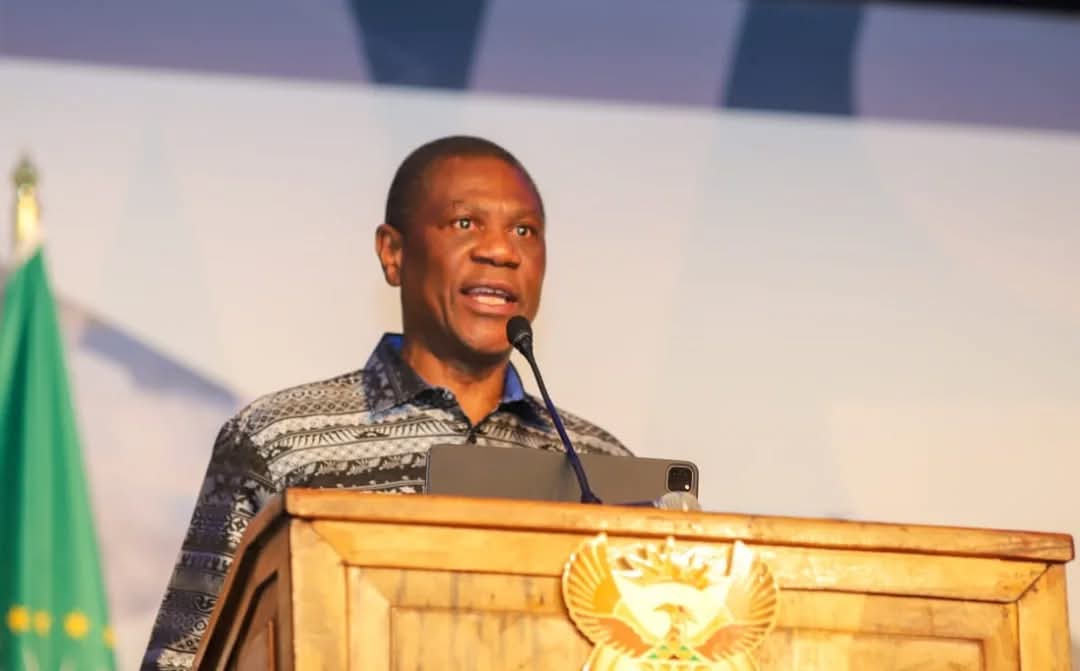
South Africa’s Deputy President Shipokosa Paulus Mashatile delivered a sobering yet resolute message on Friday, 27 March 2025 as he closed the two-day National Water and Sanitation Indaba at the Gallagher Convention Centre in Midrand, Gauteng. In his capacity as Chairperson of the Water Task Team, Mashatile underscored the critical importance of water security, urging collective action to address persistent challenges in access, infrastructure, and quality that threaten the nation’s development goals.
“Water is not just a commodity but a vital resource, one that is essential for survival of our communities and households, for businesses to operate, for the economy to grow, as well as being a central element for sustaining life itself,” Mashatile told delegates, which included government officials, water board representatives, academics, and civil society organizations. His remarks capped a summit that saw robust discussions on the country’s water woes, echoing a sentiment shared by President Cyril Ramaphosa on the Indaba’s opening day: water is a fundamental human right and a cornerstone of national progress.
Since the end of apartheid in 1994, South Africa has made strides in expanding access to clean water, with Mashatile citing an increase from “around 60% in 1994 to around 82.4% of South Africans having access to clean drinking water in 2022.” Key milestones, he noted, include the National Water Act of 1998, which aimed to ensure sustainable water management, and the rollout of infrastructure projects targeting underserved rural areas. Yet, despite these gains, the Deputy President painted a stark picture of the challenges that remain. “It should not be business as usual, when we currently have 19 percent of the rural population lacking access to a reliable water supply, and 33 percent that do not have basic sanitation services,” he said, referencing the dire state of rural schools and clinics, where “over 26 percent of all schools and 45 percent of clinics lack access to water.”
The Blue Drop Report, an audit of the nation’s drinking water quality and infrastructure, was a focal point of Mashatile’s critique. “The audit report revealed that the quality of the country’s drinking water is deteriorating,” he said, attributing much of the decline to “inadequate infrastructure for water reticulation and sanitation.” This echoes findings from the Water Task Team’s oversight visits to municipalities, where aging and unreliable systems have been identified as a primary barrier to service delivery.
Mashatile outlined a multi-pronged strategy to reverse these trends, emphasizing “improving the speed of execution and finding solutions” as the guiding philosophy of the Water Task Team. Among the interventions highlighted were the creation of a Water Partnerships Office to facilitate public-private partnerships and the Infrastructure Fund, which has secured “R23 billion for seven large water infrastructure projects.” Major projects like Phase 2 of the Lesotho Highlands Water Project and the uMkhomazi Dam are now moving forward after years of delays, while preparations for the Ntabelanga Dam in the Eastern Cape aim to bolster water supply for domestic and agricultural use.
A significant reform on the horizon is the establishment of the National Water Resources Infrastructure Agency, which Mashatile described as “one of the most significant reforms coming to the sector to date.” Mandated by President Ramaphosa, the agency will focus on expanding bulk water infrastructure and improving the management of existing assets to ensure long-term water security.
However, infrastructure alone won’t suffice. Mashatile called for an integrated approach across all spheres of government, leveraging the District Development Model (DDM) to enhance cooperative governance. “It is through partnership that we can speedily address the bottlenecks of service delivery and be accountable to each other and the people in our communities,” he said, stressing the need for oversight and accountability to yield tangible results.
The Deputy President also addressed the socioeconomic dimensions of the crisis, noting that “access to safe drinking water and sanitation is recognised as a basic human right by the United Nations and is enshrined in our Constitution.” With South Africa observing Human Rights Month, Mashatile urged reflection on both progress and setbacks, calling for a renewed commitment to equitable service delivery. “We must continue to be deliberate in our efforts to tackle the ageing infrastructure, which immensely compromises the reticulation of drinkable water supply,” he concluded, rallying delegates to turn the Indaba’s resolutions into “concrete action” to secure a sustainable water future.