


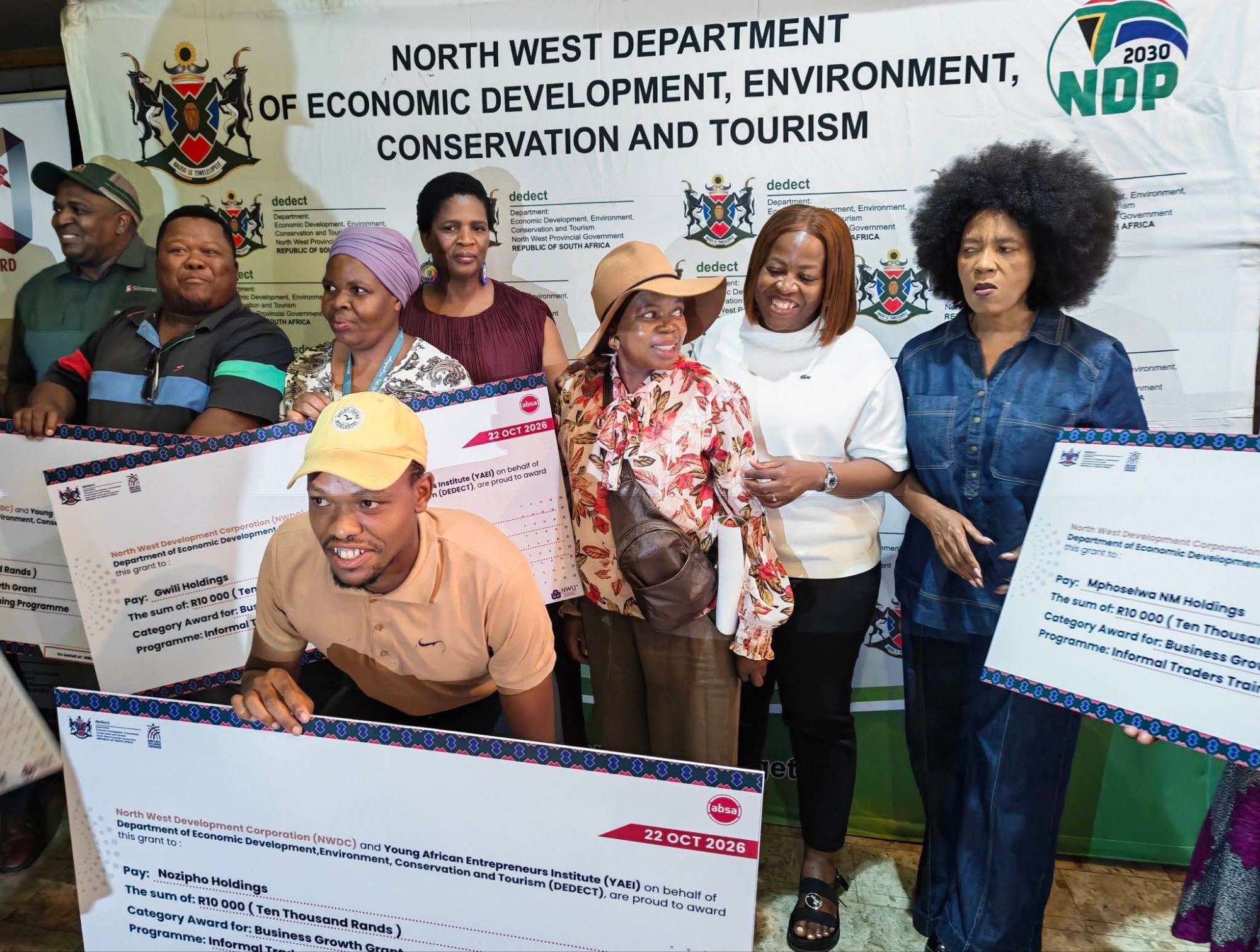
The distribution of business start up packages to 105 informal traders in the Dr Kenneth Kaunda District has highlighted a central challenge facing small enterprise support programmes in South Africa: ensuring that assistance translates into businesses capable of surviving and creating jobs over the long term.
Maropene Ramokgopa, Minister in the Presidency for Planning, Monitoring and Evaluation, and Bitsa Lenkopane, the North West MEC for Economic Development, Environment, Conservation and Tourism, officiated the handover at the Madiba Banquet Hall in Potchefstroom on Friday, October 23, 2026.
The initiative forms part of the North West provincial government’s informal business support programme, which is being implemented across all districts of the province.
While the handover provides beneficiaries with a starting point for developing their enterprises, the department says its intervention is designed to extend beyond the initial provision of equipment. Training, mentorship and aftercare are also intended to help traders strengthen their operations and build sustainable businesses.
Ramokgopa commended the department for supporting microenterprises through a structured programme that places emphasis on sustainability and continued assistance.
She said small, medium and micro enterprises were central to achieving the National Development Plan’s Vision 2030 employment objectives, particularly the ambition to expand job creation through small businesses.
The National Development Plan sets out South Africa’s long-term development ambitions, including a more inclusive economy, greater employment opportunities and reduced poverty and inequality. Supporting entrepreneurship is one avenue through which government seeks to advance those objectives.
For informal traders, however, access to equipment is only one part of building a viable business. Enterprises also need customers, reliable suppliers, sound financial management and sufficient working capital to maintain operations. The extent to which these factors are addressed can influence whether an intervention produces lasting benefits.
Lenkopane said the provincial programme was adopting a deliberate approach that included training, mentorship and aftercare. She also identified support for participation in the school nutrition programme as part of the department’s wider effort to maximise the programme’s impact.
Such participation could provide a potential market for eligible businesses, although the information released about the handover did not specify how many beneficiaries might qualify, what products they could supply or when opportunities would become available.
The MEC said programme progress and outcomes would continue to be monitored to ensure that beneficiaries developed sustainable enterprises and created lasting employment opportunities.
That commitment to monitoring is significant because the number of packages distributed, while useful as an immediate measure of delivery, does not by itself establish whether supported businesses survive, expand or employ additional workers. Those outcomes require follow up and evidence over time.
The initiative is being implemented in partnership with institutions of higher learning, development partners including YAEI and the North West Entrepreneurship Hub, and private-sector stakeholders.
These partnerships are intended to reinforce the support available to entrepreneurs beyond the handover event. In principle, training and mentorship can help traders address management and operational difficulties, while sustained engagement can identify obstacles that emerge as businesses grow.
Ramokgopa and Lenkopane praised the beneficiaries, particularly women and young people, for embracing the opportunities offered by the programme. They said entrepreneurial effort could strengthen businesses, create jobs and contribute to a more inclusive economy.
The officials described the traders’ participation as contributing to the National Development Plan’s vision of economic growth that benefits a broader section of society.
The Potchefstroom handover therefore represents both a delivery milestone and the beginning of a longer process. Its eventual success will depend on whether the beneficiaries can turn the assistance into functioning enterprises and whether the promised training, mentorship and aftercare provide the support needed to sustain them.
For the provincial government, the stated objective is clear: to build a more resilient provincial economy by strengthening small businesses. Demonstrating the programme’s lasting impact will require continued monitoring of business survival, growth and employment outcomes.


