

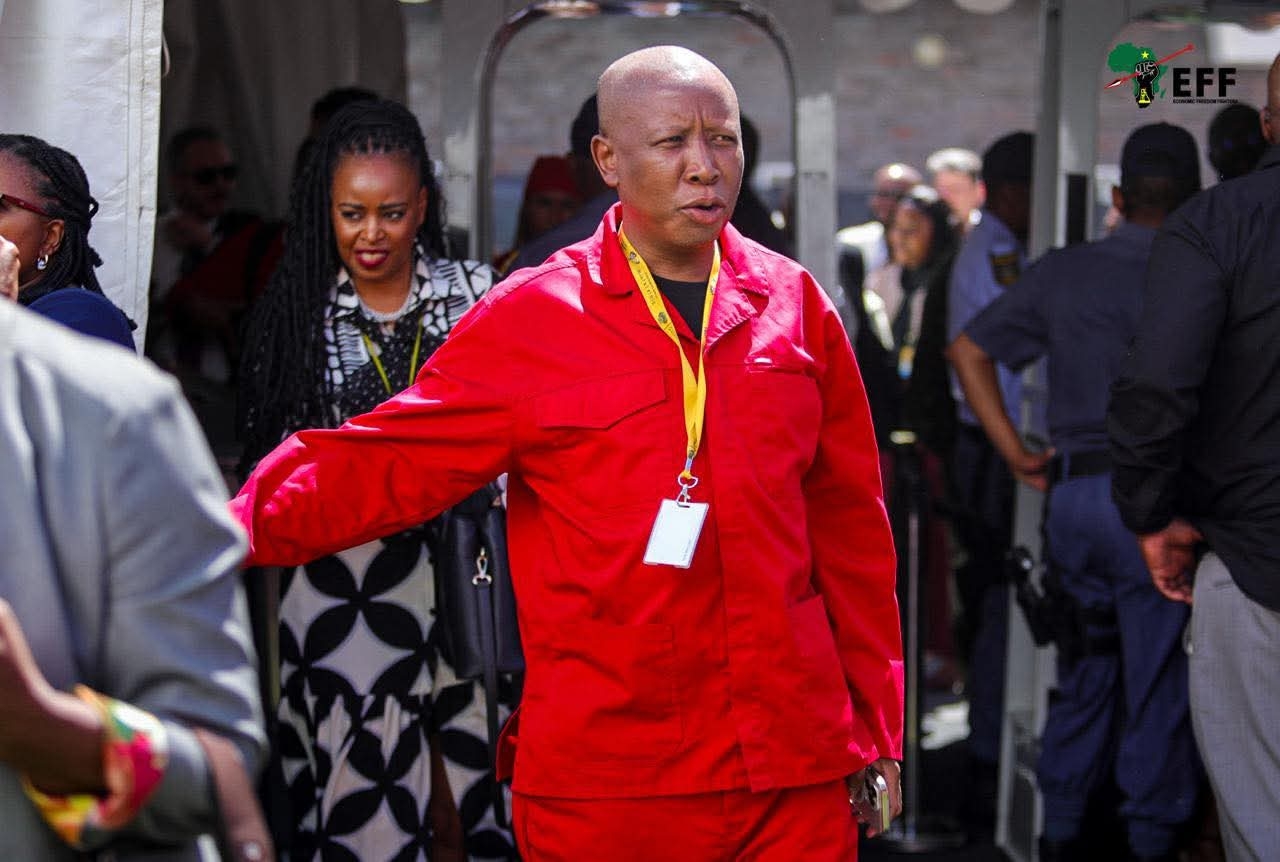
Economic Freedom Fighters (EFF) leader Julius Malema on Wednesday delivered a scathing assessment of the finance minister’s budget speech, characterizing it as a politically motivated balancing act that fails to address the country’s core economic stagnation.
In an interview following the parliamentary address, Malema acknowledged the political context of the announcement, noting it was crafted to appear “reasonable, especially with the working class” in a crucial election year. However, he argued that the underlying fundamentals remain dire.
“The reality of the matter is that the economy is not growing,” Malema stated. “Without the economy growing, we will not be able to provide jobs or grow the infrastructure. Even if the revenue service collects more revenue, it doesn’t mean economic growth. We are worried that there is no plan about how the economy is going to be increased in the country.”
Malema specifically targeted a discrepancy in government promises, pointing to the president’s recent pledge to deploy 10,000 labor inspectors. “He never allocated any money for it. They were clapping hands for it. Yet it’s not budgeted for, which means that what the president said doesn’t matter,” Malema asserted.
While conceding that the adjustment to personal income tax was “a very welcomed position” that would leave workers with more money in their pockets, Malema dismissed the broader fiscal strategy. He argued that a reported fiscal saving of 1.4 billion rand was meaningless to ordinary South Africans.
“Saving 1.4 billion does not reduce the price of bread. The price of bread is still high. The electricity is still high,” he said.
Malema reserved his strongest criticism for the government’s reliance on public private partnerships, a cornerstone of the current administration’s economic strategy. He rejected the notion that private sector involvement lowers costs for consumers, citing the recent increase in electricity prices despite private sector participation in the energy sector.
“The private sector has never helped anywhere to reduce any cost,” Malema argued. “If anything, the costs go high. The private sector never reduces any cost, if anything, they are profit driven.”
When asked what he would have done differently, Malema called for a fundamental shift in priorities. He advocated for increased investment in state owned infrastructure and capacity, rather than what he described as an attempt to “impress the IMF” and international investors.
“Wherein the people are not at the center of your budgeting, the so called investors are being impressed with this budgeting while the people on the ground are suffering,” he said. “We will concentrate more on the investment in infrastructure, building state capacity, so that we can create more jobs and ensure that we employ as many young people as possible.”
On a cautiously positive note, Malema welcomed the prospect of a new university, a long standing promise for the region, stating that its eventual realization would be “good for all of us.”