

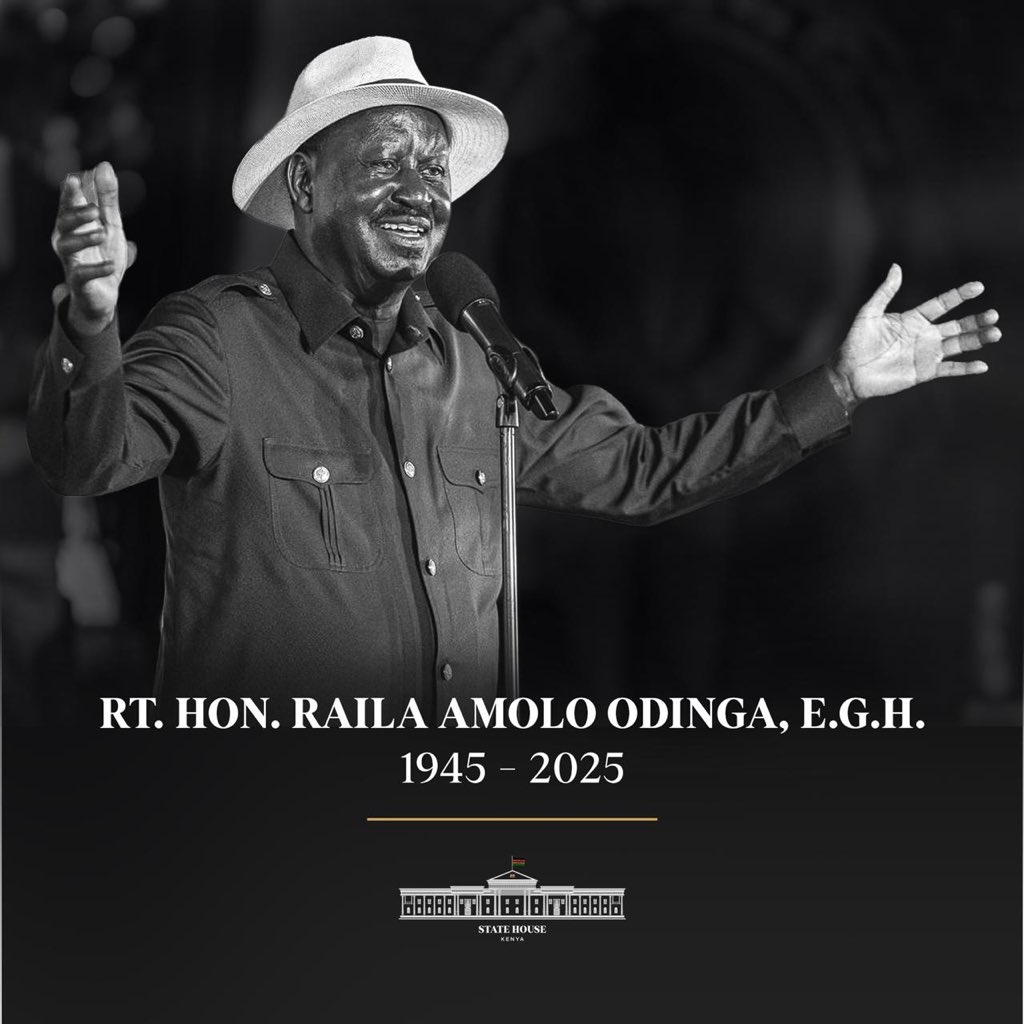
Raila Amolo Odinga, the indomitable Kenyan opposition leader who endured decades of political persecution, brokered fragile peace after national turmoil and shaped the country’s democratic evolution through five presidential bids, died on Wednesday in Kochi, India. He was 80.
Mr. Odinga, often called “Baba” or “Agwambo” by supporters, suffered a cardiac arrest during a morning walk at an Ayurvedic hospital in Koothattukulam, Ernakulam district, Kerala, where he had been receiving treatment. The news, confirmed by family members and hospital officials, sent shockwaves through Kenya, prompting spontaneous gatherings in Nairobi’s Kibera slum and Kisumu’s streets, his strongholds. President William Ruto declared a seven-day national mourning period and ordered flags flown at half-staff, hailing Mr. Odinga as “the most significant leader of our democratic experiment.”
Born on Jan. 7, 1945, in Maseno, Kisumu District, in what was then the Kenya Colony, Mr. Odinga was the son of Jaramogi Oginga Odinga, Kenya’s first vice president under founding President Jomo Kenyatta, and Mary Juma Odinga. A member of the Luo ethnic group, he grew up in a politically charged household that championed independence from British rule. His father’s fallout with Kenyatta in 1966, leading to the formation of the Kenya People’s Union, cast a long shadow over young Raila’s life, embedding him early in the currents of dissent.
Education took him abroad amid Cold War tensions. After attending Kisumu Union Primary and Maranda High School, Mr. Odinga studied German philology at the University of Leipzig and mechanical engineering at the Technische Hochschule in Magdeburg, East Germany, graduating in 1970 with a degree in welding engineering. During his time there, he navigated the Iron Curtain, smuggling goods from West Berlin to friends in the East — a tale of resourcefulness that foreshadowed his political ingenuity.
Returning to Kenya, Mr. Odinga plunged into business, founding Standard Processing Equipment Construction & Erection Ltd. in 1971, later renamed East African Spectre, which became the country’s sole manufacturer of liquid petroleum gas cylinders. He sold his cherished German car to seed the venture, showcasing the entrepreneurial grit that complemented his activism. By 1974, he had joined the Kenya Bureau of Standards as group standards manager, rising to deputy director by 1978.
Politics, however, was his inexorable calling. Kenya’s one-party state under President Daniel arap Moi suppressed dissent, and Mr. Odinga’s path intersected with it violently. In 1982, amid a failed coup attempt by Kenya Air Force soldiers that killed hundreds, he was arrested on treason charges for alleged involvement — ties later detailed in a 2006 biography that prompted calls for his rearrest, though the statute of limitations had expired. Detained without trial for six years until 1988, he missed his mother’s funeral by two months due to withheld information. Rearrested in 1988 and 1990 for pro-democracy agitation, he was released in 1991 and fled to Norway in 1991 amid assassination threats.
These ordeals forged Mr. Odinga into a human rights crusader. He joined the Forum for the Restoration of Democracy (FORD) in 1992, becoming vice chairman, and won the Langata parliamentary seat in the multiparty elections that year — a milestone in dismantling Moi’s monopoly, credited partly to his and Kenneth Matiba’s agitation. After FORD’s split, he formed the National Development Party (NDP) in 1994 following his father’s death, challenging for leadership in a bitter contest.
Mr. Odinga’s 1997 presidential run as NDP candidate yielded third place behind Moi, but he retained his parliamentary seat. In a pragmatic pivot, he merged NDP with Moi’s Kenya African National Union (KANU) in 2002, serving as energy minister from 2001 to 2002. Yet, Moi’s anointing of Uhuru Kenyatta as successor alienated him, prompting defection to the Liberal Democratic Party (LDP) and alliance with Mwai Kibaki’s National Alliance Party to form the National Rainbow Coalition (NARC). His endorsement — the Swahili rallying cry “Kibaki tosha” (“Kibaki is enough”) — propelled NARC to a landslide victory in 2002, ending KANU’s 39-year rule.
As roads minister from 2003 to 2005, Mr. Odinga revived the Kenya Railways Corporation. But Kibaki’s failure to honor a memorandum promising him the premiership and cabinet parity fractured the coalition. Mr. Odinga led the “No” campaign in the 2005 constitutional referendum, which failed 57-43, symbolizing the Orange Democratic Movement (ODM) he founded that year — its name drawn from the referendum’s ballot colors.
The 2007 election epitomized his resilience and Kenya’s fragility. As ODM candidate, Mr. Odinga launched his bid in Uhuru Park, alleging voter suppression like withheld IDs in opposition areas. Declared the loser by 232,000 votes to Kibaki on Dec. 30, 2007, the flawed tally ignited ethnic violence that killed over 1,000 and displaced 250,000. Former U.N. Secretary-General Kofi Annan mediated a power-sharing deal, installing Mr. Odinga as prime minister on April 13, 2008 — a role last held by Kenyatta in 1964, abolished thereafter until its revival in 2022.
From 2008 to 2013, sharing power with Kibaki, Mr. Odinga stabilized the economy and advanced reforms, including the 2010 Constitution that devolved power and curbed presidential authority — legacies he championed. He authored “Raila Odinga: The Flame of Freedom” in 2013, a 1,040-page memoir chronicling his struggles.
Electoral defeats defined his later campaigns. In 2013, as Coalition for Reforms and Democracy (CORD) candidate with Kalonzo Musyoka, he garnered 43.7% against Uhuru Kenyatta’s 50.5%, petitioning the Supreme Court over irregularities like faulty biometric kits; the court dismissed it but ordered an electoral probe. He boycotted Kenyatta’s inauguration, decamping to South Africa.
The 2017 race was seismic. As National Super Alliance (NASA) nominee, Mr. Odinga alleged hacking maintained an 11% gap; the Supreme Court annulled the results in a landmark 4-2 ruling for “unconstitutional” flaws, ordering a rerun. He withdrew on Oct. 10, citing unreformed electoral body, but was sworn as “People’s President” on Jan. 30, 2018, by deported activist Miguna Miguna, sparking clashes that killed 39. The “handshake” pact with Kenyatta that March sidelined Kenyatta’s deputy, Ruto, birthing the Building Bridges Initiative (BBI) to amend the Constitution for inclusivity. The Supreme Court struck down BBI in 2022 as unconstitutional.
In 2022, as Azimio la Umoja nominee with Martha Karua, Mr. Odinga’s 10-point manifesto promised universal healthcare and jobs, securing 48.95% to Ruto’s 50.5%. Another Supreme Court petition failed. Appointed African Union High Representative for Infrastructure Development in 2018 until 2023, he mediated the 2010-11 Ivorian crisis and ran unsuccessfully for AU Commission chair in February 2025.
Mr. Odinga’s personal life mirrored his public tenacity. Married to Ida Oyoo since 1973, he had four children: Fidel (died 2015), Rosemary, Raila Jr., and Winnie. A lifelong Arsenal fan and former Gor Mahia midfielder, he gifted the club 10 million Kenyan shillings ($77,000) just last week. He claimed distant kinship to Barack Obama, though disputed.
Reactions poured in globally. Ruto, once a rival, called him a “peacemaker who put country first,” ordering a state funeral. South Africa’s Cyril Ramaphosa mourned a “towering figure.” ODM Secretary-General Edwin Sifuna urged unity, while Ms. Karua expressed “great shock and sadness.” In Nairobi’s Central Business District, mourners chanted “Jowi!” his Luo nickname amid heightened security to prevent unrest. Thousands marched in Kayole and Umoja, waving flags.
Mr. Odinga’s legacy is etched in Kenya’s multiparty rebirth in 1991 and devolution reforms he fought for through detention scars and electoral scars. Never president, he was democracy’s unyielding architect, a pan-Africanist whose optimism echoed: “Our best days are yet to come.” As Kenya mourns, his flame endures, illuminating a nation he helped forge from division to dialogue.