


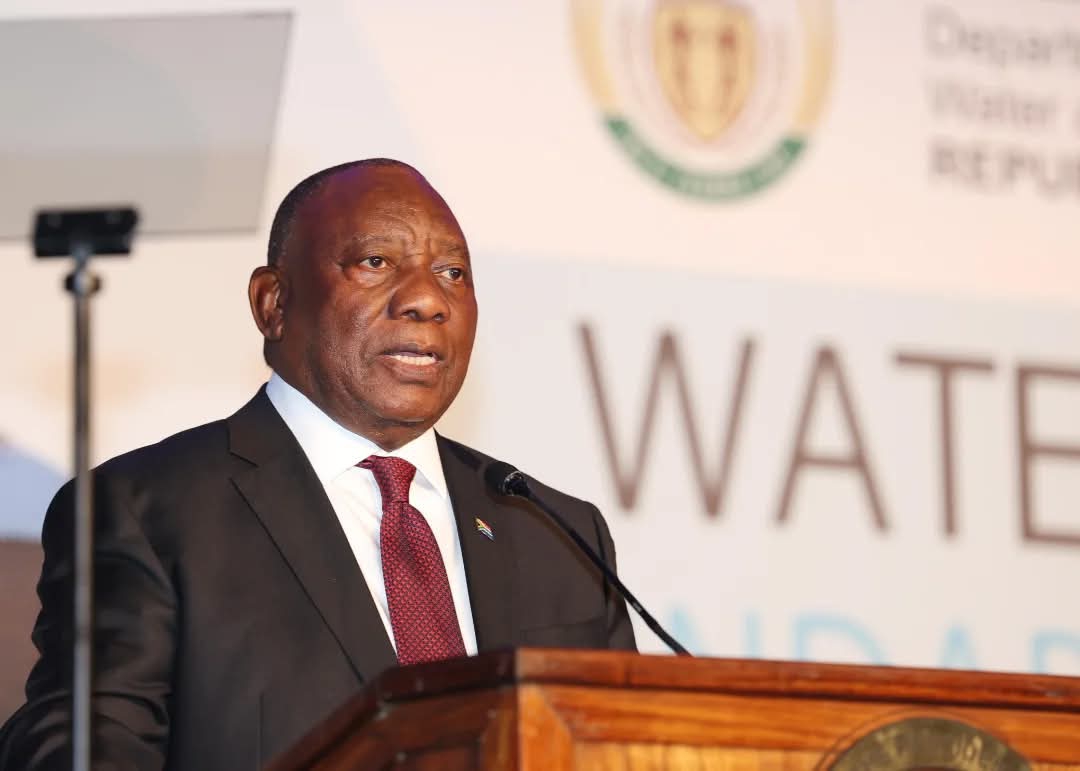
In a keynote address at the National Water and Sanitation Indaba held at Gallagher Estate in Midrand, on Thursday 27 March 2025, South African President Cyril Ramaphosa underscored the urgent need for a “national turnaround plan on water security” to address the country’s mounting challenges in providing clean water and sanitation to its citizens. Speaking to an audience of government officials, water sector stakeholders, and civil society representatives, Ramaphosa framed water stewardship as not only a strategic priority but a fundamental issue of human dignity, rooted in the nation’s Bill of Rights.
“March is Human Rights Month, and a time when we celebrate the progress we have made in giving effect to the Bill of Rights in the Constitution,” Ramaphosa said, noting that access to sufficient water is “interrelated and interdependent” with other rights, including the right to human dignity. “Beyond being a strategic national asset and a key enabler of economic growth, the provision of water is about restoring and affirming the dignity of all.”
The President highlighted significant strides made since the advent of democracy in 1994, when “approximately 30 per cent of the population lacked access to adequate water supply, and more than 50 per cent were without adequate sanitation.” Citing Census 2022 data, he pointed to improvements, with access to clean water now at 88.5 percent and improved sanitation at 80.7 percent, crediting the National Water Act of 1998 as a “key legislative enabler” in this progress. Yet, he acknowledged that South Africa remains “a long way off from achieving clean water and sanitation for all,” as outlined in Sustainable Development Goal 6.
Ramaphosa painted a sobering picture of the challenges ahead, describing a “perfect storm” of dry taps, broken infrastructure, and poor resource management fueling public discontent and social protests. He referenced the World Resources Institute, which ranks South Africa among 25 countries that are “extremely water stressed,” currently using over 80 percent of its water supply for domestic needs. The climate crisis, he warned, will only exacerbate these pressures, with sub-Saharan Africa projected to see the largest increase in water demand by 2050.
The President outlined ongoing efforts to bolster water infrastructure, including the National Infrastructure Fund’s R23 billion investment in seven large projects, the resumption of Phase 2 of the Lesotho Highlands Water Project, and preparations for the Ntabelanga Dam. “The Polihali Dam will feed 490 million cubic meters of water a year from the Lesotho Highlands into the Vaal River System,” he said, emphasizing the role of blended financing in addressing supply challenges.
However, supply is only part of the problem. Ramaphosa identified ageing infrastructure, vandalism, illegal connections, and organized crime as persistent threats to service delivery, compounded by financial mismanagement and high water losses at the municipal level. “Governance challenges and inefficiencies at the various reporting entities including the Water Boards have long been in the public domain,” he said, noting ongoing Special Investigating Unit probes into corruption and fraud.
Calling for “focused, precise and outcomes-based” deliberations at the Indaba, Ramaphosa urged stakeholders to align their efforts with the Government of National Unity’s Medium-Term Development Plan 2025-2029 and to build on reforms under Operation Vulindlela. These include the reinstatement of the Drop water quality monitoring system, a reduction in water use license processing times to 90 days for 75 percent of applications, and the publication of the Raw Water Pricing Strategy in 2024 to promote transparency.
The President also previewed forthcoming legislative changes, such as the Water Services Amendment Bill, which will introduce a licensing system for water service providers, and the establishment of the National Water Resource Infrastructure Agency by next year. “This new agency will bring strategic alignment, consistency and accountability to the various institutional arrangements for water stewardship,” he said, describing it as one of the sector’s most significant reforms to date.
As South Africa grapples with its water-scarce reality, Ramaphosa’s address served as both a call to action and a reminder of the stakes. “The people of South Africa look to this Water and Sanitation Indaba with hope, and for a clear strategy and plan on how to uphold their dignity through the provision of water and sanitation services that are their basic right,” he concluded.


