


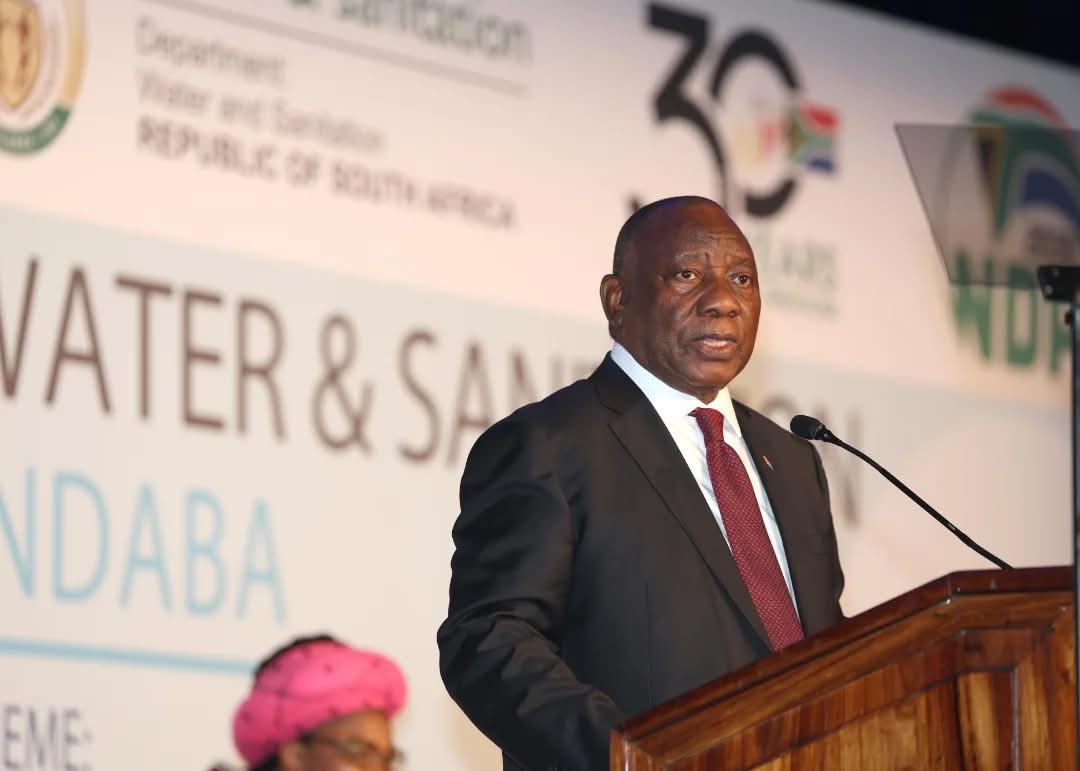
South African President Cyril Ramaphosa placed local government at the heart of the nation’s water and sanitation crisis during his keynote address at the National Water and Sanitation Indaba in Midrand on Thursday, 27 March 2025 calling for a practical plan to support municipalities in delivering these essential services. Addressing a diverse gathering of ministers, water board representatives, and civil society leaders, Ramaphosa emphasized that structural reforms in the water sector “cannot be effectively implemented without local government being strengthened.”
“Water and sanitation are key to development,” Ramaphosa said, linking the provision of these services to the restoration of human dignity, a cornerstone of South Africa’s Constitution. He praised the Department of Water and Sanitation for progress since 1994, when over half the population lacked adequate sanitation, noting that Census 2022 figures show 88.5 percent now have access to clean water and 80.7 percent to improved sanitation. Yet, he stressed, “we are still very much a long way off from achieving clean water and sanitation for all.”
The President identified a litany of municipal-level challenges undermining service delivery, including “financial mismanagement, insufficient revenue collection systems, and high levels of physical water losses.” These issues, he said, have been consistently highlighted in reports from the Municipal Strategic Self-Assessment, Stats SA, and the Auditor-General. Compounding the problem, municipalities have failed to reinvest service revenues into maintaining water infrastructure, contributing to a decline in private sector investment until recently.
Ramaphosa called on local government leadership to “prioritise turnaround strategies for their respective Water Services Authorities” and to implement recommendations from the 2024 Water Summit and Drop water quality reports. He also urged national government to use the Indaba to “chart a practical course for supporting municipalities,” pointing to underutilized resources like the Urban Settlements Development Grant and Municipal Infrastructure Grant as missed opportunities.
The President situated these domestic challenges within a broader global context, citing the World Resources Institute’s projection that sub-Saharan Africa will face the world’s largest increase in water demand by 2050. South Africa, he noted, is among 25 “extremely water stressed” nations, a vulnerability worsened by the climate crisis and a growing population. “Grievances with water and sanitation delivery are behind a number of social protests across the country,” he warned, describing a “perfect storm” of failing infrastructure and poor management.
To address these systemic issues, Ramaphosa highlighted ongoing reforms under Operation Vulindlela, including the reinstatement of the Drop water quality monitoring system and a reduction in water use license processing times to 90 days for 75 percent of applications, supported by the hiring of 110 technical and scientific staff. He also pointed to the upcoming National Water Resource Infrastructure Agency, set to be finalized next year, which will aim to streamline water stewardship accountability.
Collaboration across all levels of government and the private sector was a recurring theme in Ramaphosa’s address. “Resolving our country’s water and sanitation challenges necessitates deepened collaboration between all stakeholders in the water resources management ecosystem,” he said, calling for greater cooperation to support service delivery where it matters most—at the local level.
The President framed the Indaba as a pivotal moment, not for diagnosing well-known problems, but for delivering “course correction” through a comprehensive plan to expand access, improve infrastructure quality, and stabilize governance in the water sector. “It has been said many a time that as humans we can survive for a time without food, but without water we will perish,” he said, invoking a stark reminder of water’s existential importance. “Others have argued that unless we radically change our approach to managing this precious resource, the wars of the next century will be fought over water.”
With the eyes of a water-stressed nation upon them, delegates at the Indaba face the daunting task of translating Ramaphosa’s vision into actionable outcomes. “I wish you well in your deliberations and I look forward to the outcomes,” he concluded, signaling his expectation for results over rhetoric.


