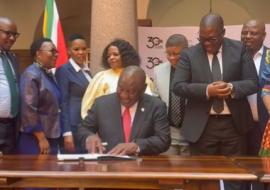
The deadline for submissions regarding the controversial Basic Education Laws Amendment (BELA) Act is fast approaching, with just three days left for public input. The Act, which was signed by President Ramaphosa on September 13, 2024, and postponed for three months for further consultations, has stirred significant debate across various sectors, particularly regarding its clauses on language and admissions policies.
The Democratic Alliance (DA) has been vocal in opposing Clauses 4 and 5 of the BELA Act, arguing that they undermine parental and school governing body control over language policies. The DA believes the government’s power to dictate these policies infringes upon democratic principles and parental rights. They have also indicated that if these clauses are not amended, they are prepared to challenge their constitutionality in court.
During this time, the minister has met with members from Solidarity, and the Presidency, at NEDLAC after a dispute was lodged by the Union. This process is entirely separate from the consultation process, and conflating the two is misleading, and factually incorrect. This was a mandatory process, in terms of the law, to prevent strike action arising out of the dispute. The outcome of this engagement was a settlement, signed by the Minister of Basic Education , the Presidency, and the Union.
On the other side of the debate, the South African Democratic Teachers Union (SADTU) has strongly rejected the agreement between the Minister of Basic Education, Siviwe Gwarube, and Solidarity regarding the BELA Act. SADTU claims it was not consulted during the process and has criticized the suspension of certain clauses as a move against transformation. The union believes that the agreement promotes minority dominance and undermines efforts for social cohesion within the education system.
SADTU has drawn parallels between the current language policies and those implemented during the apartheid era, arguing that they hinder integrated education. The union insists that language instruction should be determined democratically by communities, reflecting the demographic realities of South Africa, rather than through government mandates. They contend that these policies should not be shaped by minority interests but should focus on creating an inclusive education system that supports social unity.
We will not allow white supremacists to use the department of education to practice their racism. All schools must respect all laws and the Constitution of our country, including the right of our children to access education at any school without barriers created through language policies.
SADTU’s opposition to the agreement comes at a time when concerns are growing over the government’s engagement with Solidarity, a move many view as sidelining the union and diminishing its influence in educational reforms. The union fears that the government is following a plan to weaken their authority and exclude them from meaningful input in the development of education policies.
While Minister Gwarube has expressed her commitment to implementing the BELA Act with appropriate regulations, including its positive focus on early childhood development—an aspect the DA has supported—the union’s stance is clear. SADTU plans to take action against the agreement, continuing to advocate for education policies that promote inclusivity and transformation.
As the deadline for public submissions nears, it is clear that the BELA Act will remain a focal point of contention, with opposing factions rallying against key provisions and calling for a more inclusive and democratic approach to education reform.